
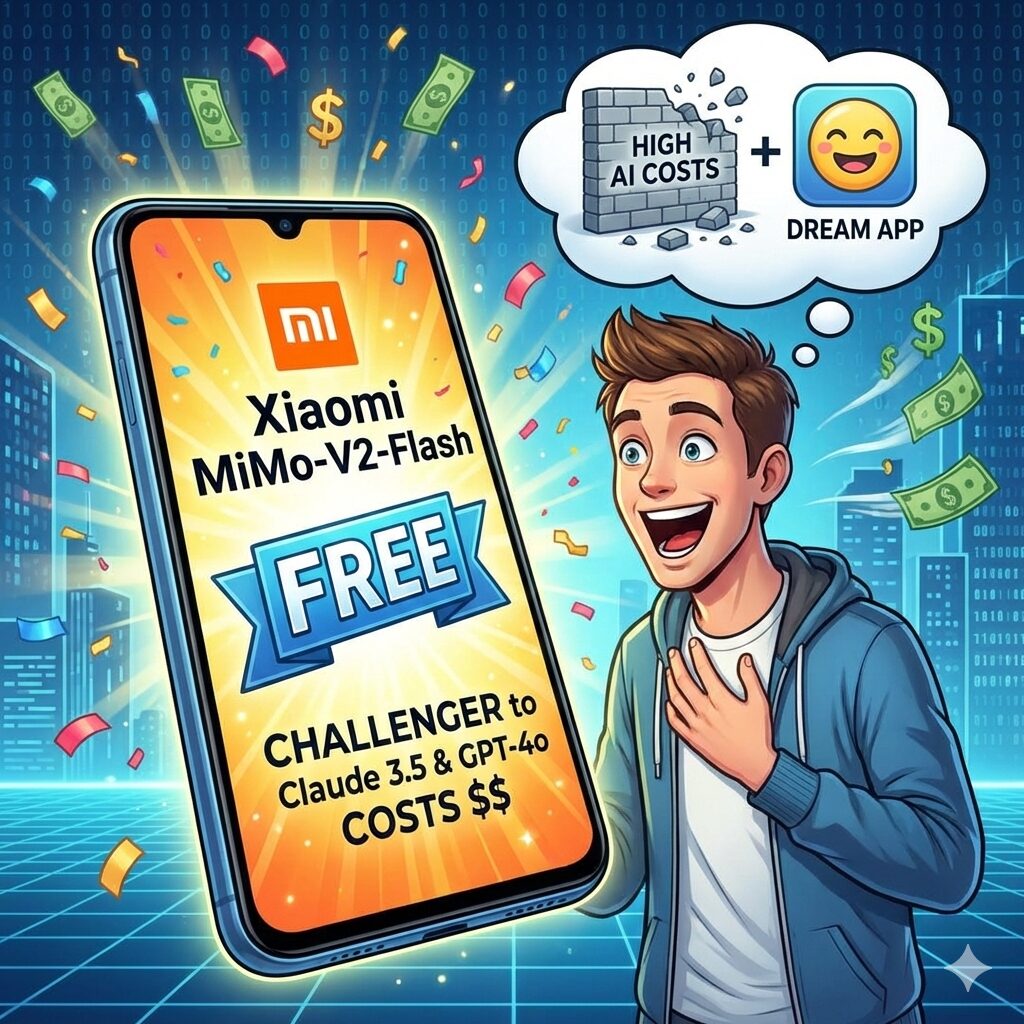

The Revolution: When a “Flash” Breaks the Monopoly
Imagine you are an ambitious software engineer, working tirelessly to build your dream application. Suddenly, you hit the wall of exorbitant costs. Utilizing state-of-the-art AI models like Claude 3.5 Sonnet or GPT-4o demands a fortune for every line of code generated or every complex query answered. Frustration sets in: how can a startup or an independent developer possibly compete with tech behemoths under such a financial burden?
It is at this critical juncture that a “flash” emerges from the East. This is no fleeting spark, but a technological whirlwind launched by Xiaomi: the Xiaomi MiMo-V2-Flash. The rules of the game have fundamentally changed. This is an open-source model with coding capabilities that rival the most powerful paid alternatives, operating at a breakneck speed that feels like real-time interaction. Most importantly, its cost is virtually zero compared to its competitors.
Xiaomi has entered the AI race with a clear, aggressive strategy, exceeding expectations with a model that doesn’t just compete—it aims to redefine the concept of “AI for everyone.” Is this merely a marketing stunt, or is the MiMo-V2-Flash truly the game-changing asset developers and users have long awaited? Let’s dive deep into this technical beast and uncover the facts.
What is Xiaomi MiMo-V2-Flash? The Technical Specifications
The Xiaomi MiMo-V2-Flash is a large language model (LLM) built on the Mixture-of-Experts (MoE) architecture. The model boasts a massive 309 billion total parameters, but thanks to its intelligent design, only 15 billion parameters are activated per request. This engineering feat allows it to combine immense power with exceptional resource efficiency.
Technical Comparison: MiMo-V2-Flash vs. Competitors
| Feature | Xiaomi MiMo-V2-Flash | Claude 3.5 Sonnet | GPT-4o |
| Architecture | MoE (309B Total / 15B Active) | Dense (Undisclosed) | MoE (Undisclosed) |
| Context Length | 256,000 Tokens | 200,000 Tokens | 128,000 Tokens |
| Generation Speed | Ultra-Fast (via MTP) | Fast | Very Fast |
| Cost | Open-Source / Negligible API Cost | Paid / High API Cost | Paid / High API Cost |
| Access | Local + Cloud | Cloud Only | Cloud Only |
The Secret to Speed: Multi-Token Prediction (MTP) Technology
One of the most significant innovations in the Xiaomi MiMo-V2-Flash is the native integration of a Multi-Token Prediction (MTP) unit. Unlike traditional models that predict one token at a time, MiMo generates multiple tokens simultaneously. This technology effectively triples the generation speed, making it an ideal candidate for latency-sensitive tasks like coding assistance and real-time chat.
Performance Deep Dive: Is MiMo-V2-Flash a Serious Coding Tool?
When it comes to coding, the benchmarks speak for themselves. In SWE-Bench tests—which measure a model’s ability to resolve real-world software issues from GitHub—MiMo-V2-Flash achieved impressive results, matching the performance of Claude 3.5 Sonnet. Crucially, it does so at a fraction of the cost, approximately 2.5% of Claude’s price point.
Key Strengths in Programming and Logic:
- Long-Context Comprehension: With a context window of up to 256,000 tokens, the model can ingest massive codebases and understand the complex relationships between different files and code segments without losing focus.
- Code Accuracy: The model has demonstrated high proficiency in generating accurate React and Tailwind CSS code. Developers can verify its output quality directly on platforms like CodePen.
- Logical Reasoning: MiMo excels at solving complex mathematical problems and sequential logical reasoning tasks, often outperforming models with a significantly higher active parameter count.
How to Leverage Xiaomi MiMo-V2-Flash “For Free”
The model’s accessibility is one of its greatest assets. Xiaomi has ensured that its use is flexible and available to everyone:
1. Direct Experience via Xiaomi MiMo Studio
You can immediately test the model’s capabilities through the official Xiaomi MiMo Studio web platform. The interface is simple, fast, and allows you to test its chat and coding prowess without any complex setup.
2. Local Deployment via LM Studio (For Professionals and Privacy)
For developers prioritizing data privacy or requiring offline functionality, the model can be downloaded from Hugging Face and run locally on your machine using tools like LM Studio. This method guarantees complete control and a near-zero operational cost (aside from electricity and hardware wear).
Local Deployment Requirements: What Hardware Do You Need?
While MiMo-V2-Flash is open-source and “free” in terms of direct cost, running it locally requires substantial compute power due to its massive 309B total parameter count. However, modern Quantization techniques (like Q4) make this feasible for advanced users.
For efficient and fast operation, especially for coding and long-context tasks, the following minimum technical requirements are recommended when using Q4 Quantization:
| Component | Minimum Recommended (with Q4 Quantization) | Notes |
| Video RAM (VRAM) | 24 GB | Ideally, use GPUs like the RTX 3090 or RTX 4090. Dual 16GB cards can also be utilized. |
| System RAM (RAM) | 64 GB | 128 GB is recommended for seamless operation with extremely long contexts. |
| CPU | Modern Multi-Core Processor | Ryzen 7 or Intel Core i7 (10th Gen or newer) is preferred to support high-speed data transfer. |
Important Note: These specifications are for efficient, high-speed operation. Running the model at full precision (FP16) would necessitate a GPU Cluster (e.g., 4x A100 or H100), which is beyond personal hardware capabilities. Therefore, utilizing quantization-supporting software like LM Studio is the key to unlocking MiMo-V2-Flash’s power on a personal device.
3. For Developers via Hugging Face
The model’s repository on Hugging Face provides all necessary files for developers to integrate MiMo-V2-Flash into their custom applications, with full support for the Transformers library and Safetensors.
4. API Key: Cloud Access at “Near-Free” Cost
Recognizing that not all developers have powerful local hardware, Xiaomi has provided a cloud solution. The Xiaomi MiMo API Open Platform offers API access, combining the model’s power with the flexibility of the cloud.
Unbelievable Pricing: Competing at 2.5% of the Cost
The most disruptive element of the MiMo-V2-Flash is its aggressive API pricing, clearly designed to revolutionize the market. The cost comparison is summarized below:
| Model | Input Cost (per Million Tokens) | Output Cost (per Million Tokens) |
| Xiaomi MiMo-V2-Flash | $0.10 | $0.30 |
| GPT-4o (OpenAI) | $5.00 | $15.00 |
| Claude 3.5 Sonnet (Anthropic) | $3.00 | $15.00 |
As the table demonstrates, the API cost for MiMo-V2-Flash is a minuscule fraction of its competitors, making it up to 50 times cheaper than GPT-4o for input tokens. This aggressive pricing makes it the definitive choice for developers building high-volume, token-intensive applications, guaranteeing high performance at a virtually “near-free” operational cost.
Getting Started with the API
To begin, register on the Xiaomi MiMo API Open Platform to obtain your API key. You can then integrate the model into your applications using simple HTTP requests or through popular LLM libraries like LiteLLM, which directly supports the Xiaomi model. This ensures developers can easily transition from other models to MiMo-V2-Flash without radical code changes.
The Verdict: A Winning Deal, Not a Stunt
After analyzing the specifications and user experiences, we can confidently state that the Xiaomi MiMo-V2-Flash is a winning deal by all metrics, especially for developers and startups.
Why is it a winner? Because it shatters the cost barrier without compromising quality. Achieving performance that closely matches Claude 3.5 Sonnet in coding, and doing so in an open-source package, is a monumental technical achievement.
Does it challenge the giants? Absolutely. In specific domains like coding, logical reasoning, and long-context processing, MiMo is a fierce competitor. While larger models like GPT-4o may retain a slight edge in general creative tasks and cultural nuance, MiMo’s targeted excellence is undeniable.
Conclusion: The Future of AI is Accessible
Xiaomi’s entry into the AI race with the MiMo-V2-Flash sends a clear message to the world: powerful AI should not be exclusive to those with deep pockets. Thanks to its innovative MoE architecture and the revolutionary MTP technology, any developer can now possess a formidable “electronic brain” on their personal device.
If you are looking for a tool to accelerate your application development at minimal cost, or if you want to explore new AI horizons without the constraints of monthly subscriptions, the MiMo-V2-Flash is your next destination. Don’t hesitate to try it today and share it with your fellow engineers—the true technological revolution is one that starts with tools accessible to everyone.
